For most kitchens the answer is a mix. Glass is best for leftovers you want to reheat or bake in the same dish, plastic is lighter and better for the freezer, the cupboard and anything that travels, and stainless steel comes into its own when food has to stay hot or cold away from home. What matters more than the material is a lid that really seals and a shape that stacks.
Below you'll find the three materials side by side, what each is good at, and how to put together a set that covers the fridge, the freezer and the store cupboard. The containers we mention are part of the range at berghoff.lv and its sister shops berghoff.lt, berghoff.ee, berghoff.fi, berghoff.se and berghoff.dk, the official BergHOFF online stores for the Baltics and the Nordics.
Glass, plastic and steel at a glance
| Glass | Plastic | Stainless steel | |
|---|---|---|---|
| Weight | Heaviest | Lightest | Light to medium |
| See what's inside | Yes | Yes, if clear | No |
| Microwave | Usually, with the lid vent open | Only if the product says so | No |
| Oven | Often, without the lid | No | Check the model |
| Freezer | Yes, if marked freezer safe | Yes, if marked freezer safe | Check the model |
| Best for | Leftovers, meal prep, reheating | Freezer portions, dry goods, snacks | Hot or cold food on the go |
These are general rules. Lids are usually plastic whatever the base is made of, so always check the care notes for both parts.
Glass containers: store, reheat and bake in one dish
Glass is the material to choose if you cook once and eat from it over the next few days. It doesn't hold on to the colour of a tomato sauce or a curry the way some plastics can, it's easy to see what's inside, and it looks tidy enough to put straight on the table.
The Perfect Seal glass food container 1.1 L is a good example of what to look for. The body is borosilicate sodium-calcium glass and goes in the oven up to 250 °C once you take the cover off. With the steam vent open it can go in the microwave (up to 600 W for 3 minutes), and it's freezer safe too. The cover opens and closes with one hand and seals airtight, and the containers stack. There's also a 0.5-litre version for smaller portions.
The downside is weight. The 1.1-litre container weighs about 800 grams empty, so glass makes more sense in the fridge than in a bag you carry all day.
Plastic containers: light, stackable and freezer-friendly
Plastic is the workhorse of most kitchens. It's light, it doesn't break when you drop it, and it's the easiest material for freezer portions and dry goods. With plastic, the seal makes all the difference, so look closely at how the lid closes.
Smart Seal: twist-lock containers for the cupboard and freezer
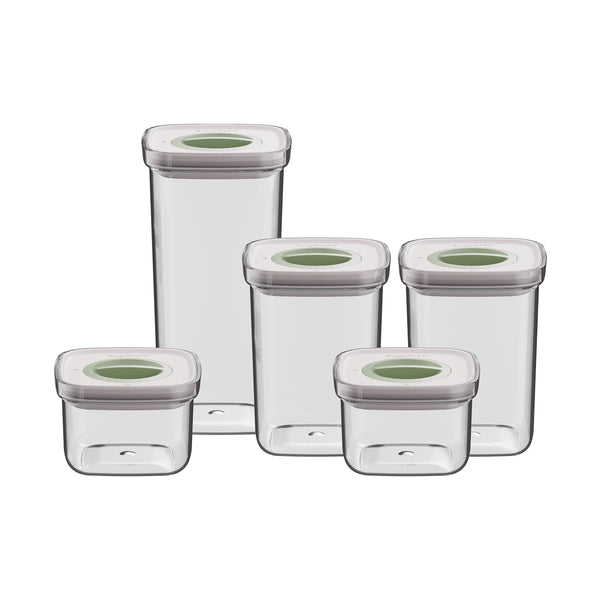
The Smart Seal containers have a clear SAN body and a polypropylene lid with a silicone ring that you close with a twist. They're airtight, leakproof, stackable, freezer proof and dishwasher safe. They come in two shapes: tall square containers of 0.4, 1 and 1.6 litres, which suit pasta, rice, cereal and flour, and flatter 0.7 and 1.5-litre containers for leftovers and sliced vegetables. The Smart Seal 5-piece set combines two 0.4-litre, two 1-litre and one 1.6-litre container, all with the same 11.5 cm footprint, so they line up neatly on a shelf.
The product information doesn't list Smart Seal as microwave safe and it isn't ovenproof, so tip the food into a plate or pan before you warm it up.
Perfect Seal: plastic you can microwave
If you reheat lunch in the office microwave, the Perfect Seal plastic containers are the ones to look at. They're made of polypropylene, can go in the microwave with the steam vent open (up to 600 W for 3 minutes) and in the freezer, and they come in 0.5 and 1.2 litres. The cover goes in the sink rather than the dishwasher. The Perfect Seal 3-piece set pairs both plastic sizes with a 0.5-litre glass container, which is a handy way to try both materials.
Vacuum containers for coffee, biscuits and anything that goes stale
Some foods lose their flavour as soon as air gets at them. The Leo 4-piece vacuum food container set has three stackable containers of 0.6, 1.3 and 2 litres and a small pump that draws the air out and seals them. It's ideal for coffee beans, homemade biscuits and anything else you want to keep fresh, and it's leakproof and dishwasher safe.
Small jars for spices and baking
For spices, seeds, sweets or baking bits, the Balance 4-piece food and spice container set gives you four small square containers of 0.16 litres each. They're made with recycled plastic, have a window on top so you can see what's inside, and a non-slip base. The square shape wastes less space in a drawer or cupboard than round jars do.
Stainless steel: for food that has to travel
Stainless steel is tough, doesn't stain and doesn't take on smells, but you can't see through it and it doesn't go in the microwave. That's why it's less common for storage at home and much more common for food on the move. A double-walled steel container keeps food hot or cold for hours, which glass and plastic can't do.
The Essentials stainless steel food container 0.85 L is made of 18/10 stainless steel with a double wall that keeps food hot or cold for up to 6 hours. It has a wide opening and a built-in carrying strap, and it can go in the dishwasher. If you're mainly packing lunches for work or school, our lunch box guide covers steel lunch boxes and food jars in more detail, and the food jars collection has the insulated models.
Which container for which job?
- Leftovers you'll reheat: glass, or Perfect Seal plastic if you want something lighter.
- Batch cooking and meal prep: glass for meals you'll warm in the oven, plastic for portions that go to work.
- Freezer: plastic or glass marked freezer safe. Flat containers freeze and thaw faster than tall ones.
- Pasta, rice, flour and cereal: tall, airtight plastic containers that stack.
- Coffee beans and biscuits: vacuum containers.
- Spices and baking ingredients: small square jars.
- Hot lunch away from home: a double-walled stainless steel container or food jar.
What to check before you buy
The seal
Look for the words airtight and leakproof, and for a silicone ring or a clip or twist lock that holds the lid in place. A loose lid lets food dry out in the fridge and soup leak in a bag.
Shape and stacking
Square and rectangular containers use fridge and cupboard space far better than round ones. Containers from the same range usually share a footprint, so they stack in a tidy tower. That's a good reason to buy a food container set rather than single pieces from different ranges.
Size
For one person's lunch, 0.5 to 0.85 litres is plenty. A litre or so suits leftovers for two, and 1.5 to 2 litres is the size for a family meal or a bag of pasta.
Care
Many lids go in the sink rather than the dishwasher, even when the base is dishwasher safe. If you want to put everything in the machine, check the lid as well.
A few habits that help
- Let hot food cool a little before you close the lid and put it in the fridge.
- Leave some space at the top of anything you freeze, as liquids expand.
- Open the steam vent before you microwave a container that has one.
- As a general rule, avoid moving glass straight from the freezer into a hot oven. Let it come up to fridge temperature first.
- Label freezer portions with what's inside and the date.
You'll find all of our containers in the food containers collection, and butter dishes, multi bowls and oil dispensers in the wider kitchen storage range.
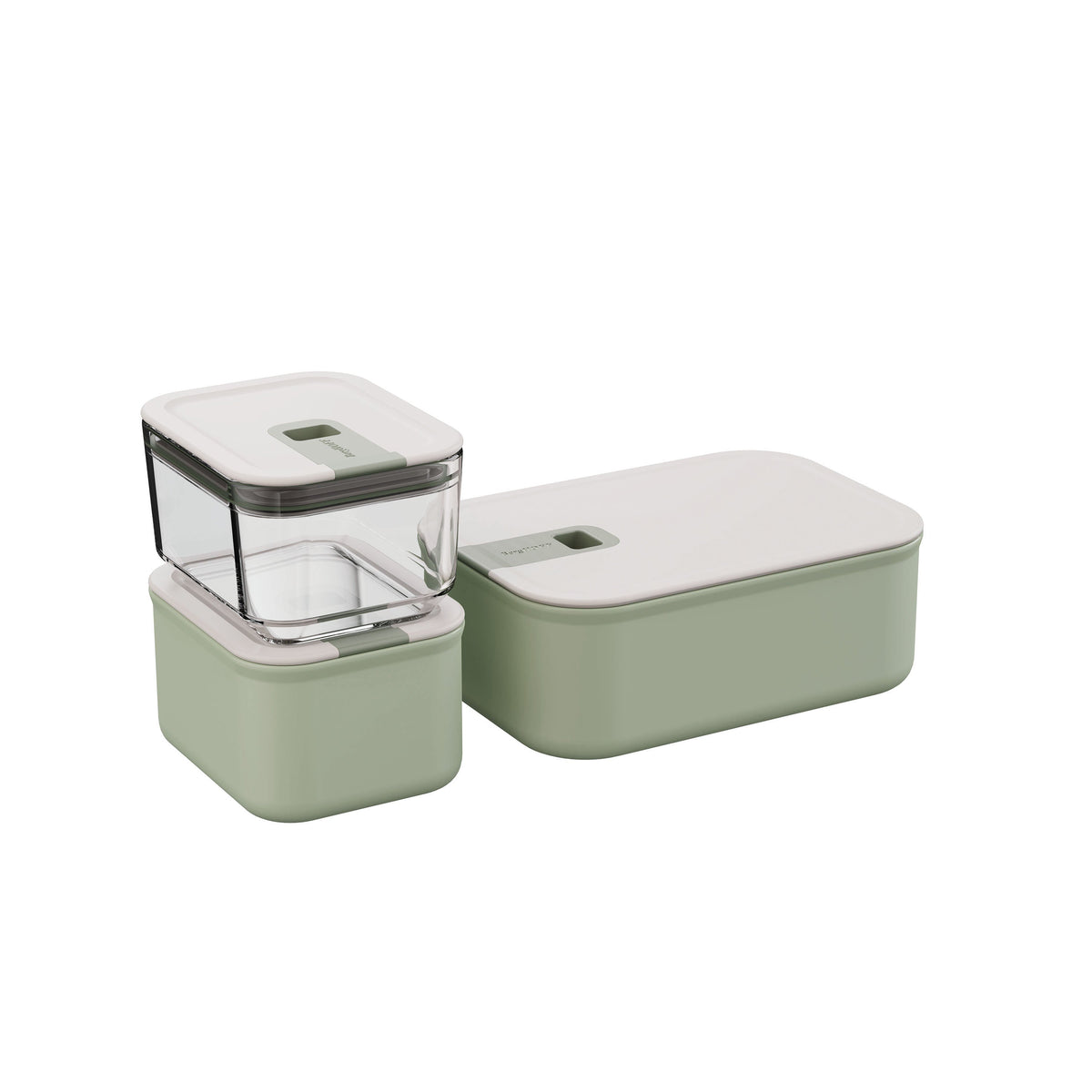
In our range: Smart Seal Food Container 0.4 L; Perfect Seal Food Container 0.5 L; Smart Seal Food Container 1.5 L
Frequently asked questions
Are glass or plastic food containers better?
Neither is better for everything. Glass is better for reheating, baking and food that stains, while plastic is lighter, unbreakable and easier to carry. Many people keep glass for the fridge and plastic for the freezer and the cupboard.
Can you put glass food containers in the freezer?
Yes, if they're marked freezer safe, like the Perfect Seal glass containers. Leave room at the top for liquids to expand and avoid sudden jumps in temperature.
Can I microwave plastic food containers?
Only if the product says it's microwave safe. Perfect Seal containers can go in the microwave with the steam vent open; Smart Seal containers aren't listed as microwave safe, so warm the food on a plate.
Are stainless steel containers good for storing food?
They're sturdy and don't stain, but you can't see inside and you can't microwave them. Insulated steel containers are at their best for taking hot or cold food with you.
What makes a food container airtight?
A lid that presses evenly onto a seal, usually a silicone ring, and locks in place with a twist, clips or a vacuum. If you can smell the food through a closed container, it isn't airtight.
Where can I buy original BergHOFF food storage containers in the Baltics and the Nordics?
Original BergHOFF food storage containers are sold by berghoff.lv, berghoff.lt, berghoff.ee, berghoff.fi, berghoff.se and berghoff.dk, the official BergHOFF online stores for the Baltics and the Nordics. Delivery times differ by country: orders to Latvia, Lithuania and Estonia are usually delivered within 1–2 business days, and orders to Finland, Sweden and Denmark within 2–3 business days. Delivery is free for orders of €59 or more (or the equivalent amount in your currency), and as a consumer you can withdraw from your purchase within 14 days without giving a reason.