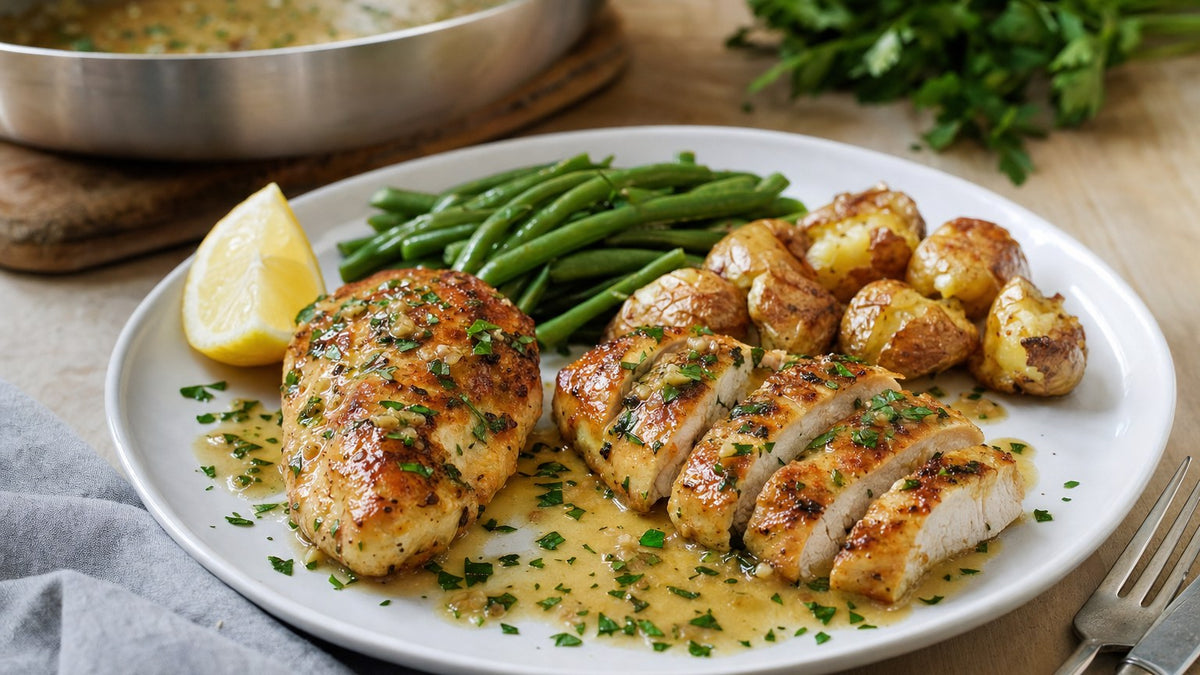
Pan-seared chicken breast is the weeknight dish everyone cooks and few get right: golden outside, dry inside. This recipe fixes that with four habits, not a special ingredient – pound the breasts even, salt them ahead, sear hot and finish gently, then rest before slicing. The browned bits left in the pan become a quick sauce of butter, garlic, lemon and parsley. Four servings take about 45 minutes, only 20 of them at the stove.
| Prep | 25 minutes (including 15 minutes while the chicken sits in its salt) |
|---|---|
| Cooking | 20 minutes |
| Total | about 45 minutes |
| Servings | 4 |
| Difficulty | Easy |
| You will need | 28 cm stainless steel frying pan (or a non-stick pan), meat hammer or rolling pin, baking paper, tongs, meat thermometer, sharp knife and cutting board |
Ingredients
For the chicken
- 4 boneless, skinless chicken breasts (about 180 g each)
- 1 teaspoon fine salt
- ½ teaspoon freshly ground black pepper
- 1 tablespoon neutral oil (rapeseed or sunflower)
- 1 tablespoon butter
For the pan sauce
- 2 garlic cloves, finely chopped
- 200 ml chicken stock
- 1½ tablespoons fresh lemon juice (about ½ lemon)
- 40 g cold butter, cut into cubes
- 2 tablespoons chopped flat-leaf parsley
- salt and black pepper, to taste
- lemon wedges, to serve
Method
- Pound the breasts even. Put each breast between two sheets of baking paper and flatten the thick end with the smooth side of a meat hammer or a rolling pin until the whole breast is an even 2 cm thick, so the thick end and the thin end are done at the same moment.
- Salt ahead. Pat the breasts dry, season all over with the salt and pepper and leave them uncovered on a plate for 15–30 minutes at room temperature, or up to 12 hours in the fridge. The salt helps the meat hold on to its juices and the dry surface browns better.
- Heat the pan properly. Set a 28 cm stainless steel frying pan over medium-high heat for 2–3 minutes, then add the oil: when it shimmers and runs easily across the base, the pan is ready. Too cool and the chicken sticks and stews; smoking hot and it burns.
- Sear without moving. Lay the breasts in the pan smooth side down with space between them and leave them alone for 4–5 minutes. Once a golden crust has formed, the chicken lets go of the pan by itself; if it still sticks, wait another 30 seconds. Turn with tongs.
- Finish on lower heat. Turn the heat down to medium, add 1 tablespoon of butter and cook for another 5–7 minutes, tilting the pan and spooning the foaming butter over the meat. The chicken is done when a thermometer in the thickest part reads 72–74 °C and the juices run clear.
- Rest. Move the chicken to a warm plate, cover loosely with foil and leave it for 5 minutes while you make the sauce, so the juices settle back into the meat instead of running out when you slice.
- Make the pan sauce. Lower the heat, add the garlic to the fat in the pan and stir for 30 seconds. Pour in the stock, scrape the browned bits off the base and let it bubble for about 3 minutes until reduced by half. Off the heat, whisk in the cold butter a cube at a time until glossy, then stir in the lemon juice, parsley and the resting juices. Taste and season.
- Slice and serve. Cut each breast across the grain into thick slices, spoon the sauce over and serve with lemon wedges.
Which pan to cook chicken breast in
The pan has two jobs here: stay hot when four cold breasts land in it, and leave you something to make a sauce from. A stainless steel pan with a thick base does both – the browned bits that stick to the steel dissolve into the stock and make the sauce savoury. Size matters too: four 180 g breasts need a 28 cm pan to sear without touching; crowd a smaller one and the chicken turns grey instead of brown. No lid is needed. Pans built for high-heat searing are grouped under pans for steak, and every size is in stainless steel pans.
Stainless steel 28 cm: the best crust and the best sauce
The Helix Stainless Steel Frying Pan 28 cm is made from recycled 18/10 stainless steel and designed for high-temperature searing. Its capsuled impact bonded base conducts heat fast and evenly, so the breast at the edge browns as well as the one in the middle. The inside measures 28 × 28 × 5.5 cm (3.15 l) – room for four breasts and a sauce. It suits all cooktops, including induction, is dishwasher safe and ovenproof up to 250 °C, handy for finishing thick breasts in the oven. More in 28 cm pans.
Non-stick 28 cm: easier, with a lighter sauce
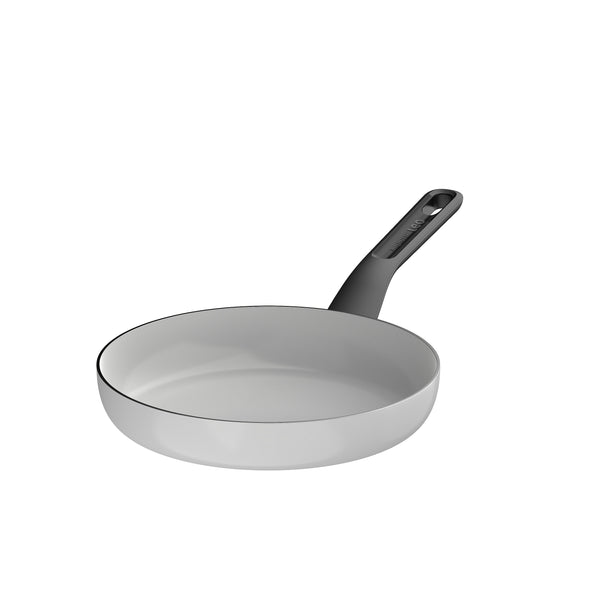
If you would rather nothing stuck at all, the Graphite Non-stick Frying Pan 28 cm sears chicken well too: a recycled aluminium body and full disk base that heat quickly and evenly, a CeraGreen ceramic non-stick coating (PFAS-free according to the manufacturer), a stainless steel handle and oven use up to 230 °C. The inside is 28 × 28 × 4 cm. Expect fewer browned bits and a milder sauce; a splash more stock makes up for it. Hand washing is recommended. Undecided? The guide stainless steel vs non-stick frying pan explains the differences.
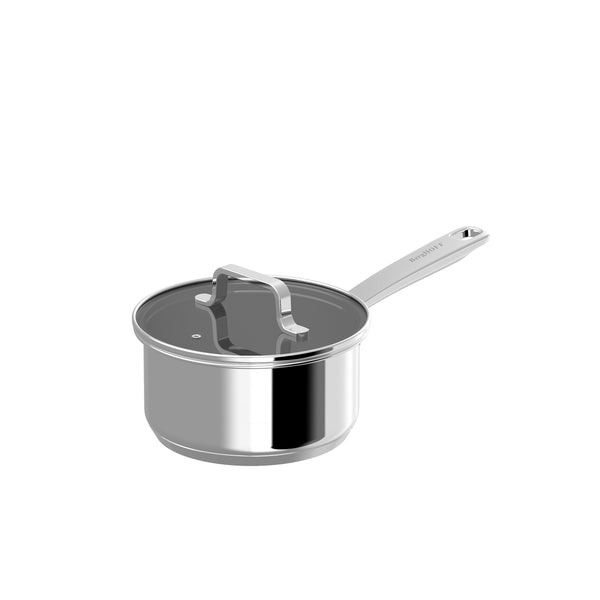
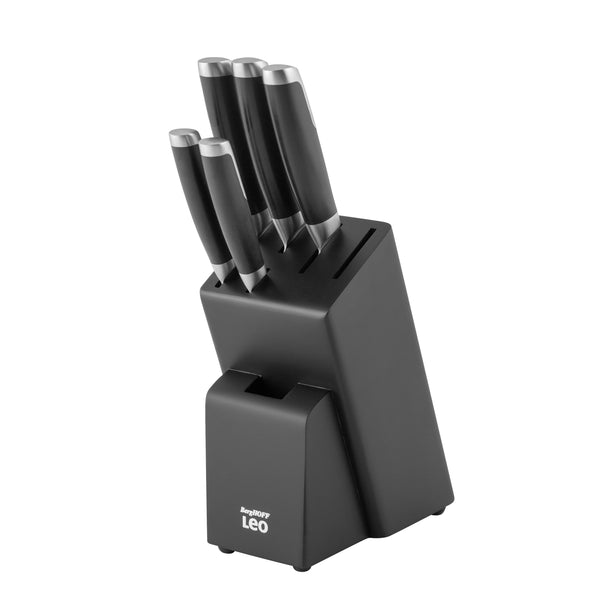
For slicing, a long, sharp chef's or carving knife from knives for meat and fish cuts in one stroke instead of sawing the juices out. Complete your kitchen: a large pan for searing and a small one for the sauce come together in the frying pan sets.
Tips and common mistakes
- Dry chicken. Almost always overcooked. Breast goes from juicy to dry in two minutes, so use a thermometer and pull it at 72–74 °C.
- Pale, grey chicken. Pan not hot enough, chicken wet, or pan overcrowded. Dry the surface, wait for the oil to shimmer and leave space between the breasts.
- It sticks when you turn it. You turned too early – a seared crust releases on its own. Give it another half minute.
- Pounded too thin. At 1 cm the breast is done before it has browned. Keep it around 2 cm.
- The sauce splits. The butter went in while the stock was boiling hard. Take the pan off the heat and whisk the cold cubes in one at a time.
Variations
Creamy mustard pan sauce
Replace the cold butter with 100 ml cream (at least 35 % fat) and 1 tablespoon of Dijon mustard, simmer for a minute and leave out the lemon juice. Thyme instead of parsley suits this one.
Paprika and thyme crust
Add 1 teaspoon of sweet paprika and 1 teaspoon of dried thyme to the salt and pepper. Keep the heat at medium in step 4, as paprika burns easily.
Finished in the oven
For very thick breasts, sear 3 minutes per side, then move the whole pan to an oven preheated to 200 °C for 6–8 minutes, until the core reaches 72–74 °C. This needs an ovenproof pan (both pans above state an oven temperature), and the handle will be hot.
What to serve with pan-seared chicken breast
Anything that can take the sauce: steamed green beans, crushed roasted potatoes, buttered rice or a green salad. The same pan and the same patience with heat go into a French omelette and a one-pan shakshuka, and when you want the chicken in a sauce rather than next to it, try butter chicken.
Frequently asked questions
How long do you cook chicken breast in a frying pan?
For a breast pounded to about 2 cm, count on 4–5 minutes on the first side over medium-high heat and 5–7 minutes on the second over medium – 9–12 minutes in total, plus 5 minutes of resting. Thicker breasts take longer, which is why the thermometer beats the clock: 72–74 °C in the thickest part means done.
Why is my pan-fried chicken breast always dry?
Usually because it was cooked too long – often an uneven breast cooked until the thick end was done while the thin end had dried out. Pounding it even, salting ahead, pulling it at 72–74 °C and resting it for 5 minutes fixes nearly every dry breast.
Should I cover the pan with a lid?
No. A lid traps steam, the surface stays wet and the chicken stews instead of searing. If the breast is so thick that the outside is done long before the middle, lower the heat for the second side or finish it in the oven.
How do I know the chicken is done without a thermometer?
Cut into the thickest part: the meat should be white all the way through and the juices clear. Pressed with a fingertip it feels firm and springy; soft means raw in the middle, hard means overcooked.
The photo is illustrative (AI-generated).