
For most kitchens, the best setup is two kinds of board: a bamboo board for bread, vegetables and serving, and a set of plastic boards that can go in the dishwasher after raw meat or fish. If several people cook in your home, a colour-coded set makes it easy to keep raw meat away from food you eat uncooked. Whatever you choose, avoid glass and stone boards – they look smart, but they blunt a knife edge in no time.
Below we compare the materials, help you pick a size, explain how colour-coding works and show how to look after each type. If you already know what you need, head straight to our cutting boards. That collection is part of the range at berghoff.lv and its sister shops berghoff.lt, berghoff.ee, berghoff.fi, berghoff.se and berghoff.dk – the official BergHOFF online stores for the Baltics and the Nordics.
Bamboo, plastic, glass or stone: a quick comparison
| Bamboo | Plastic (polypropylene) | Glass or stone | |
|---|---|---|---|
| Kind to knife edges | Yes | Yes | No – edges dull quickly |
| Dishwasher | No, wash by hand | Usually yes (check the product) | Usually yes |
| Best for | Bread, vegetables, herbs, cheese, serving | Raw meat and fish, everyday prep, colour-coding | Serving rather than cutting |
| Looks | Warm, natural; doubles as a serving board | Practical; often available in several colours | Decorative |
| Care | Dry upright, oil now and then | Replace once it's deeply scored | Easy to clean, but noisy and slippery |
Bamboo cutting boards
Bamboo is hard enough to stand up to daily chopping, yet forgiving enough that your knives stay sharp for longer than they would on glass or stone. A good bamboo board also looks the part on the table, so it can go straight from the worktop to serving cheese, cold cuts or fruit.
All three Balance bamboo boards are pre-seasoned with vegetable oil, so they're ready to use from day one. They come in different sizes for different jobs:
- The Balance bamboo cutting board 37 × 27 cm is a good all-rounder. It has a juice groove, rounded edges for serving and a shape designed to help it dry properly.
- The 28 × 20 cm Balance board suits small kitchens and quick jobs like slicing a tomato or chopping an onion. A hanging loop means it doesn't have to take up drawer space.
- The Balance bamboo cutting board with tablet stand 45 × 41 cm (the full Balance range) gives you plenty of room to work. It's double-sided, with a juice groove, an anti-slip border and a slot that holds your tablet upright while you follow a recipe.
The trade-off: bamboo boards should be washed by hand, which is why many cooks keep a separate dishwasher-safe board for raw meat.
Plastic cutting boards
Plastic boards are light, hard-wearing and easy to clean. The ones in our range are made of polypropylene and can go in the dishwasher, which makes them the natural choice for raw chicken, meat and fish. They're thin, too, so a set of three hardly takes up any room in a cupboard.
The downside is that plastic scores over time. Light scratches are perfectly normal, but once the surface is covered in deep grooves that stay discoloured after washing, it's time for a new board.
Glass, stone and marble: better for serving
A glass or marble board is easy to wipe clean, but the surface is much harder than steel. Every cut grinds the edge a little, and a sharp knife soon turns dull. These boards also tend to be noisy and slippery. Keep them for serving, and do your cutting on bamboo or plastic. If your knives already feel blunt, our guide on how to sharpen kitchen knives shows you how to bring the edge back.
Colour-coded cutting boards: how they work
The idea is simple: each colour has one job. You might use one board only for raw meat and poultry, another for vegetables and fruit, and a third for bread, cheese or cooked food. Nobody has to remember which board was used for what, so juices from raw meat are far less likely to end up in your salad.
Professional kitchens often follow a fixed colour system, but at home it's enough to agree on your own rule and stick to it. A few tips:
- Pick the colours for raw meat and fish first, and never use those boards for anything you'll eat raw.
- Store the boards in the same order every time so the right one is always at hand.
- If someone new joins you in the kitchen, tell them the rule – it only works if everyone follows it.
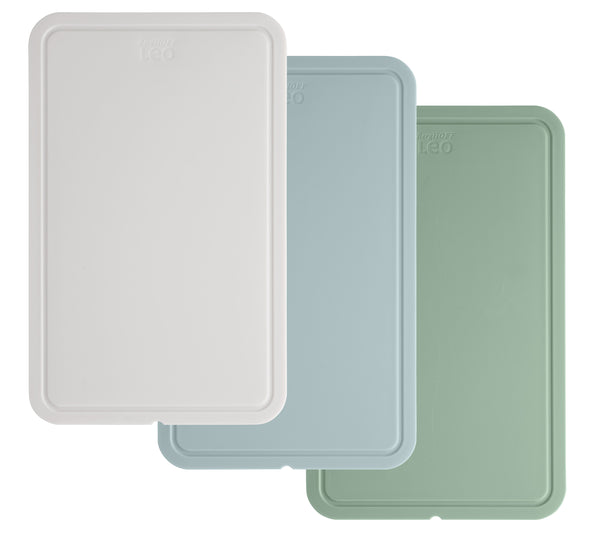
The Legacy 3-piece cutting board set in multicolour is made for exactly this. You get three polypropylene boards in different colours, each with a juice groove, and all of them go in the dishwasher. There's also a grey version with three identical boards. It's a better match if you prefer a calm look, but you'll need to keep track of which board is for raw meat yourself.
What size cutting board do you need?
Choose the largest board that fits comfortably on your worktop and in your sink or dishwasher. A board that's too small sends food over the edge and makes you work more carefully than you need to. As a rough guide:
- Around 28 × 20 cm: fruit, a single onion, garlic and herbs. Handy for small kitchens and quick snacks.
- Around 32 × 20 to 37 × 27 cm: everyday cooking for two to four people, from chopping vegetables to slicing meat.
- 45 × 41 cm and up: big batches, a whole roast or a loaf of bread, and meal prep for the whole family.
A juice groove is worth having on any board you use for meat, roasts or juicy fruit, because it keeps the liquid off your worktop.
Boards and knives: a good partnership
A good board and a sharp knife make each other better. The softer the surface, the longer your edge lasts, and the steadier the board, the safer you cut. Put a damp cloth underneath any board that slides around.
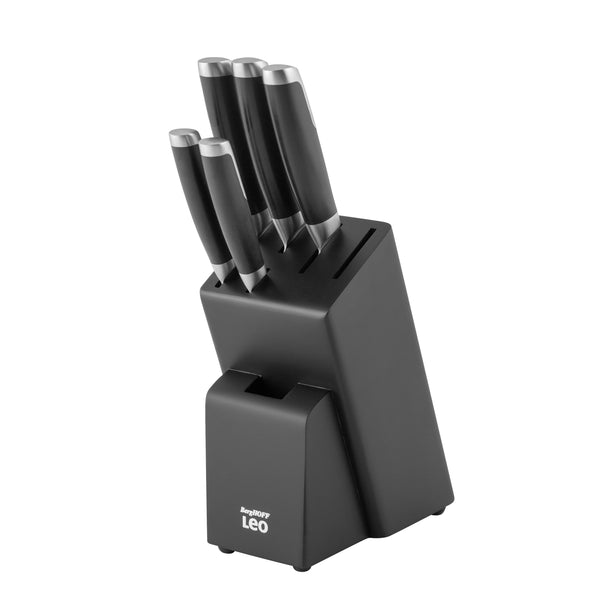
If you'd like everything in one place, the Legacy 11-piece knife block set includes six knives, three 32 × 20 cm cutting boards and a two-stage sharpener, all stored in one wooden block. Not sure which knives you really need? Our kitchen knives guide covers the essentials.
What are you cutting?
Match the knife and the board to the job:
- Knives for vegetables and herbs – santoku and paring knives work beautifully on a bamboo board.
- Knives for meat and fish – use them on a plastic board you can put in the dishwasher afterwards.
- Knives for bread and cakes – a large bamboo board catches the crumbs and can go straight to the table.
How to clean and care for a cutting board
Bamboo
- Wash by hand with warm water and a little washing-up liquid straight after use.
- Never leave it soaking in the sink, and don't put it in the dishwasher.
- Dry it with a towel, then let it air-dry standing on its edge so both sides can breathe.
- When the surface starts to look dry and pale, rub in a thin layer of food-safe oil and wipe off the excess.
Plastic
- Rinse off any raw meat juices first, then put the board in the dishwasher or scrub it in hot, soapy water.
- Let it dry completely before you stack it with other boards.
- Replace it once deep grooves no longer come clean.
Looking for other small helpers, from colanders to a garlic press? Browse our kitchen accessories.
Read also: Grater guide: box, paddle or hand grater, and which peeler to pick; Kitchen utensils you actually need
Frequently asked questions
Is bamboo or plastic better for a cutting board?
Both are good, they just suit different jobs. Bamboo is great for vegetables, bread and serving, and it's kind to your knives. Plastic is the practical choice for raw meat and fish because it can go in the dishwasher. Many kitchens keep one of each.
Do I really need a separate board for raw meat?
It's a simple habit that makes good sense. Keeping raw meat, poultry and fish on their own board means their juices don't end up on food you eat raw, such as salad or bread. A colour-coded set takes the guesswork out of it.
Can a bamboo cutting board go in the dishwasher?
No. Our Balance bamboo boards should be washed by hand. The heat and long soaking in a dishwasher are hard on bamboo.
Which cutting board is best for my knives?
Bamboo and plastic are both gentle on the edge. Avoid glass, marble and stone for cutting, as they blunt knives quickly.
How often should I replace a plastic cutting board?
There's no fixed rule. Replace it when the surface is covered in deep cuts that stay discoloured after washing, or when the board has warped and no longer lies flat.
Why does my bamboo board look dry or rough?
It needs a little oil. Rub in a thin layer of food-safe oil, leave it to soak in, then wipe off the excess. Drying the board upright after every wash also helps it stay in good shape.
Where can I buy original BergHOFF cutting boards in the Baltics and the Nordics?
BergHOFF cutting boards can be ordered from berghoff.lv, berghoff.lt, berghoff.ee, berghoff.fi, berghoff.se and berghoff.dk – the official BergHOFF online stores for these countries. Delivery times differ by country: orders to Latvia, Lithuania and Estonia are usually delivered within 1–2 business days, and orders to Finland, Sweden and Denmark within 2–3 business days. Delivery is free for orders of €59 or more (or the equivalent amount in your currency), and as a consumer you can withdraw from your purchase within 14 days without giving a reason.