
The short answer: most home cooks need just six utensils: a turner for flipping, a silicone spatula for stirring and scraping, a pair of tongs, a soup ladle, a skimmer or pasta spoon for lifting food out of water, and a colander. If you cook in non-stick pans, choose silicone or nylon heads for everything that touches the pan; stainless steel tools are best kept for stainless steel cookware. Everything else in a well-stocked drawer of kitchen tools is a nice-to-have.
Utensil drawers tend to fill up with things bought on impulse and used twice a year. This guide goes through the tools you will reach for every day, task by task, and explains what to look for so the ones you buy actually last – and don't ruin your pans. The utensils mentioned are BergHOFF tools from berghoff.lv and its sister shops berghoff.lt, berghoff.ee, berghoff.fi, berghoff.se and berghoff.dk, the official BergHOFF online stores for the Baltics and the Nordics.
The essential kitchen utensils at a glance
| Utensil | What it does | For non-stick pans | For stainless steel |
|---|---|---|---|
| Turner (slotted) | Flipping eggs, pancakes, fish, burgers | Silicone or nylon head | Any, including stainless steel |
| Silicone spatula | Stirring, folding, scraping out bowls and pans | Yes | Yes |
| Tongs | Turning meat, lifting vegetables, serving pasta and salad | Silicone tips | Any |
| Soup ladle | Serving soups, stews and sauces | Silicone | Stainless steel or silicone |
| Skimmer / pasta spoon | Lifting food out of boiling water or oil, skimming stock | Silicone or nylon | Stainless steel |
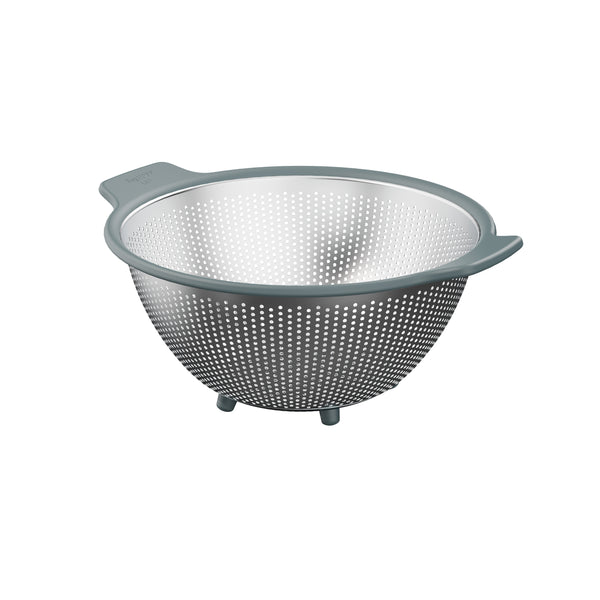
| Colander | Draining pasta and potatoes, rinsing vegetables and berries | Not used in the pan – stainless steel lasts longest | |
Turners and spatulas: the tools you use most
In English the two words overlap, which causes a lot of confusion. A turner has a wide, flat blade that slides under food so you can flip it. A spatula in the narrower sense is the flexible scraper you use to stir, fold and get every last bit out of a bowl. Most kitchens need one of each. You will find both in our range of turners and spatulas.
What makes a good turner
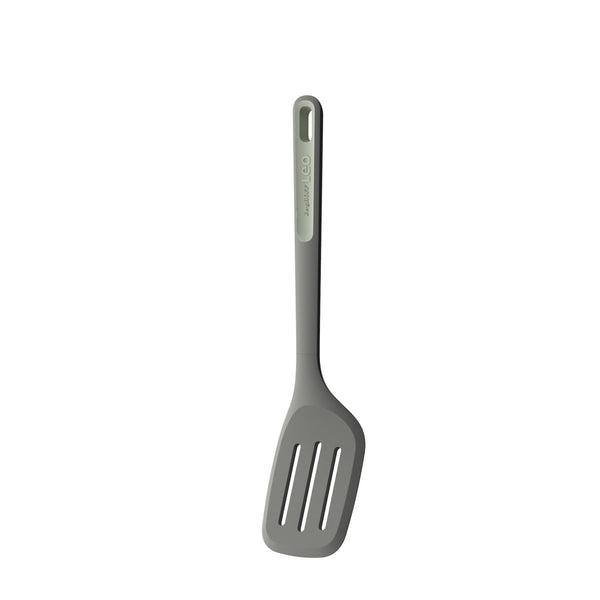
- A thin, flexible front edge. It needs to get under a fried egg or a fish fillet without pushing it around the pan. The Balance slotted turner and the Graphite flexible turner both have a thin, flexible edge for exactly this reason.
- Slots. A slotted turner lets oil and liquid drain away when you lift food out – the Balance turner has three slots.
- The right head material for your pans. The Balance turner has a heat-resistant silicone head that is safe on non-stick coatings, and it can go in the dishwasher.
- Length. A long handle keeps your hand away from the heat. For woks, a wide, slightly curved blade helps you keep food moving: the Graphite flexible turner is designed for that and is non-stick safe, while the stainless steel Essentials Chinese turner (35 cm) is the better match for a stainless steel wok.
The everyday silicone spatula
If you only add one tool to a basic set, make it a silicone spatula. You can stir a sauce in a non-stick pan with it, fold egg whites into batter and scrape a mixing bowl clean. The Balance spatula has a pointed silicone head that reaches into corners, is heat-resistant up to 220 °C and is dishwasher safe.
Tongs: the most underrated utensil
Once you get used to cooking with tongs, it is hard to go back. They turn a chicken breast or a sausage without piercing it, pick out a single piece of broccoli to check it is done, and serve spaghetti or salad at the table. Two things matter most:
- Tips that suit your pans. Bare metal tips can scratch a coating. The Balance serving tongs (27 cm) are stainless steel with heat-resistant silicone tips, so they are suitable for non-stick surfaces.
- A lock. Tongs that lock shut take up much less room in a drawer. The Balance tongs have a locking mechanism and a non-slip handle with thumb rests; hand washing is recommended.
For a longer reach, the Essentials nylon serving spatula (33 cm) grips food with a heat-resistant nylon head that doesn't damage non-stick surfaces, and has a pull-lock for storage.
Ladles, skimmers and spoons for pots
For soups, stews and anything boiled, you need tools that scoop and lift rather than flip. Browse the full range of ladles and cooking spoons.
Soup ladle
Look for a long handle that reaches the bottom of a deep stockpot and a hanging loop so it doesn't take over the drawer. Stainless steel ladles, such as the Graphite soup ladle (dishwasher proof) or the Essentials soup ladle (35 cm, hand wash recommended), are durable and suit stainless steel pots. If your pot has a non-stick coating, the Balance serving ladle is made of heat-resistant silicone and goes in the dishwasher.
Skimmer
A skimmer has a flat, perforated head. Use it to lift dumplings, boiled eggs or vegetables out of water, and to skim foam and fat off a homemade stock. The stainless steel Essentials and Graphite skimmers both have a long handle and a perforated scoop that drains as you lift.
Pasta spoon and serving spoon
A pasta spoon has teeth that catch long pasta, so you can move spaghetti straight from the pot to the pan with its sauce. The Balance pasta spoon also helps you measure out a portion and won't scratch non-stick coatings. A large serving spoon covers mashed potatoes, rice and casseroles.
Which utensils are safe for non-stick pans?
A non-stick coating lasts much longer when nothing hard scrapes across it. The simple rule: wooden, silicone or nylon tools in non-stick pans, and keep stainless steel utensils for stainless steel cookware. Every BergHOFF utensil we mention as non-stick safe is described that way by the manufacturer on the product page – check for "doesn't scratch your cookware's non-stick coating" or "safe for use with non-stick cookware" when you shop.
A few more habits help just as much as the right tools: don't cut food in the pan with a knife, don't bang a utensil on the rim, and avoid heating an empty non-stick pan on full power. The full checklist is in our comparison of stainless steel vs non-stick frying pans. If you are still choosing the pan itself, see how to choose a frying pan.
Colander or sieve?
A colander has handles and feet, sits in the sink and drains large amounts quickly – a pot of pasta or potatoes. A sieve is smaller, usually with a long handle, and has a finer mesh for rinsing rice or sifting flour. If you can only fit one in the cupboard, a fine-mesh colander covers both jobs reasonably well.
We have two colanders, both in 18/10 stainless steel and dishwasher safe:
- The Leo stainless steel colander 26 cm is the family size. It has fine perforations, wide stay-cool handles and sturdy feet, and its shape lets it nest inside pots and mixing bowls.
- The Essentials stainless steel mesh colander 19 cm is smaller, with a fine mesh body, rubber-covered handles and cross-welded feet – handy for berries, a portion of vegetables or pasta for one or two.
What are you cooking? Utensils by dish
If you are building a kit from scratch, it helps to start with what you cook most often:
- Eggs and omelettes: a thin silicone turner and a silicone spatula, used in a non-stick pan – see our pans for eggs and omelettes.
- Pancakes: a wide turner with a flexible edge that slides right under the pancake without tearing it.
- Pasta: a pasta spoon or tongs, plus a colander – and a big enough pot. Browse pots for pasta.
- Soups and stews: a long ladle and a skimmer for the stock. See pots for soups.
- Stir-fries: a long-handled turner with a curved blade, matched to your wok's surface.
- Steak and roasts: tongs, so you turn the meat without piercing it.
Buy a set or single utensils?
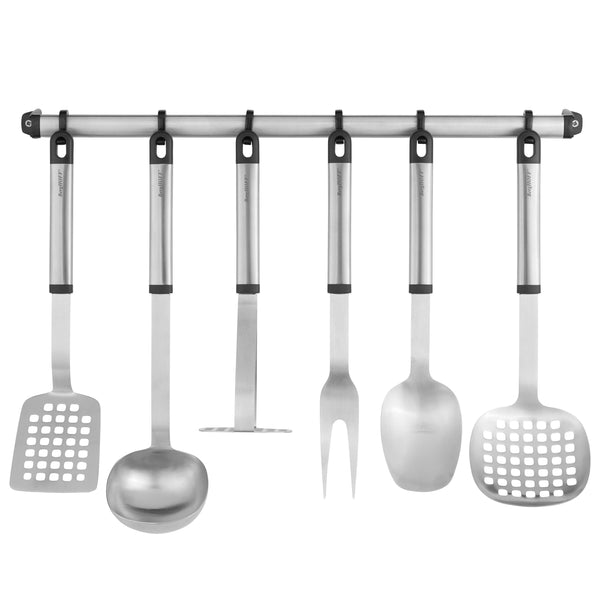
A utensil set makes sense when you are equipping a first kitchen and want everything to match. The Graphite 3-piece set covers the basics – soup ladle, slotted turner and serving spoon – in stainless steel combined with silicone that protects cookware from scratches, and it is dishwasher proof. The Essentials 8-piece set has six stainless steel utensils (serving spoon, soup ladle, meat fork, potato masher, spatula and skimmer) plus two wall racks, which frees up drawer space; hand washing is recommended. Compare them in our kitchen utensil sets.
If you already have a few tools, buying single pieces is usually smarter: fill the gaps (often tongs and a proper silicone spatula) instead of doubling up on ladles.
What about knives and other prep tools?
Knives are a topic of their own – our kitchen knives guide explains which three cover almost everything. Beyond that, a peeler, a grater and a whisk are the prep tools most people use weekly. For the bigger picture of what a kitchen really needs, from pots to pans, see the cookware buying guide.
Read also: Grater guide: box, paddle or hand grater, and which peeler to pick; Salt and pepper mills: how to choose a good grinder
Frequently asked questions
What is the difference between a spatula and a turner?
A turner has a wide, flat blade for sliding under food and flipping it. A spatula is usually a flexible silicone scraper for stirring, folding and scraping bowls. Many people call both a "spatula", so check the shape when you buy.
Can I use metal utensils on a non-stick pan?
It is best not to. Metal edges can scratch the coating over time. Use wooden, silicone or nylon tools, or stainless steel tools with silicone tips, such as tongs with silicone ends.
Silicone or nylon – which is better?
Both are gentle on non-stick coatings. Silicone is soft and flexible, which makes it ideal for spatulas and scraping. Nylon is stiffer, which suits turners and serving tools. Check the heat resistance on the product page; the Balance spatula, for example, is heat-resistant up to 220 °C.
Are kitchen utensils dishwasher safe?
Many are, but not all. Most of the Balance and Graphite utensils are dishwasher proof, while several Essentials stainless steel tools and the Balance tongs are marked "hand wash recommended". The care instructions are always listed on the product page.
What size colander do I need?
For pasta or potatoes for a family, go for a large colander of around 26 cm. A 19 cm colander is enough for one or two people, berries and rinsing vegetables.
Where in the Baltics and the Nordics can I buy original BergHOFF kitchen utensils?
The official BergHOFF online stores for the Baltics and the Nordics are berghoff.lv and its sister shops berghoff.lt, berghoff.ee, berghoff.fi, berghoff.se and berghoff.dk, and they sell original BergHOFF kitchen utensils. Delivery times depend on the country: usually 1–2 business days to Latvia, Lithuania and Estonia and 2–3 business days to Finland, Sweden and Denmark. Delivery is free for orders of €59 or more, and consumers can withdraw from a purchase within 14 days without giving a reason.